The Formal Operator Training Program is a three-year program designed to develop the required skills, knowledge, and competencies of new hire operators. Any deviation to program content or required times must be approved by the business unit Area Section Head and documented on a KR-988, Training Program Waiver form. This waiver is used for extenuating circumstances and requests are considered by the Area Section Head on a case-by-case basis.
NOTE: Operator Trainees are not eligible to apply for other posted positions.
This training program incorporates the following:
The following diagram illustrates the process by which new hire Operators advance through the qualification process as they move from an initial new hire trainee to a Fully Qualified Operator (FQO).
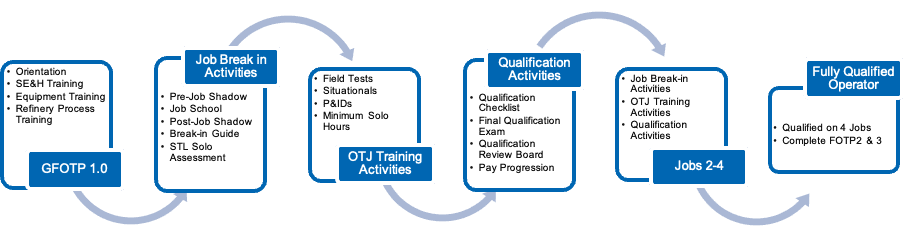
Figure 1: Trainee Training Process Overview
A trainee must complete all required GFOTP courses, OTJ training, and Qualification Activities associated with four individual jobs to become a Fully Qualified Operator (FQO). Trainees must qualify on the first job within 12 months of hire date, and on the second job within 24 months of hire date. Jobs three and four must be completed within 36 months of hire date. Non-vacation approved absences may result in an extension of the training period. Extensions are considered on a case-by-case basis. The STL consults with the HRBP to determine length of extension, if any. A Training Program Waiver form, KR-988, must be approved by the Area Section Head indicating circumstances, length of extension if any, and pay progression advances or holds until requirements are met.
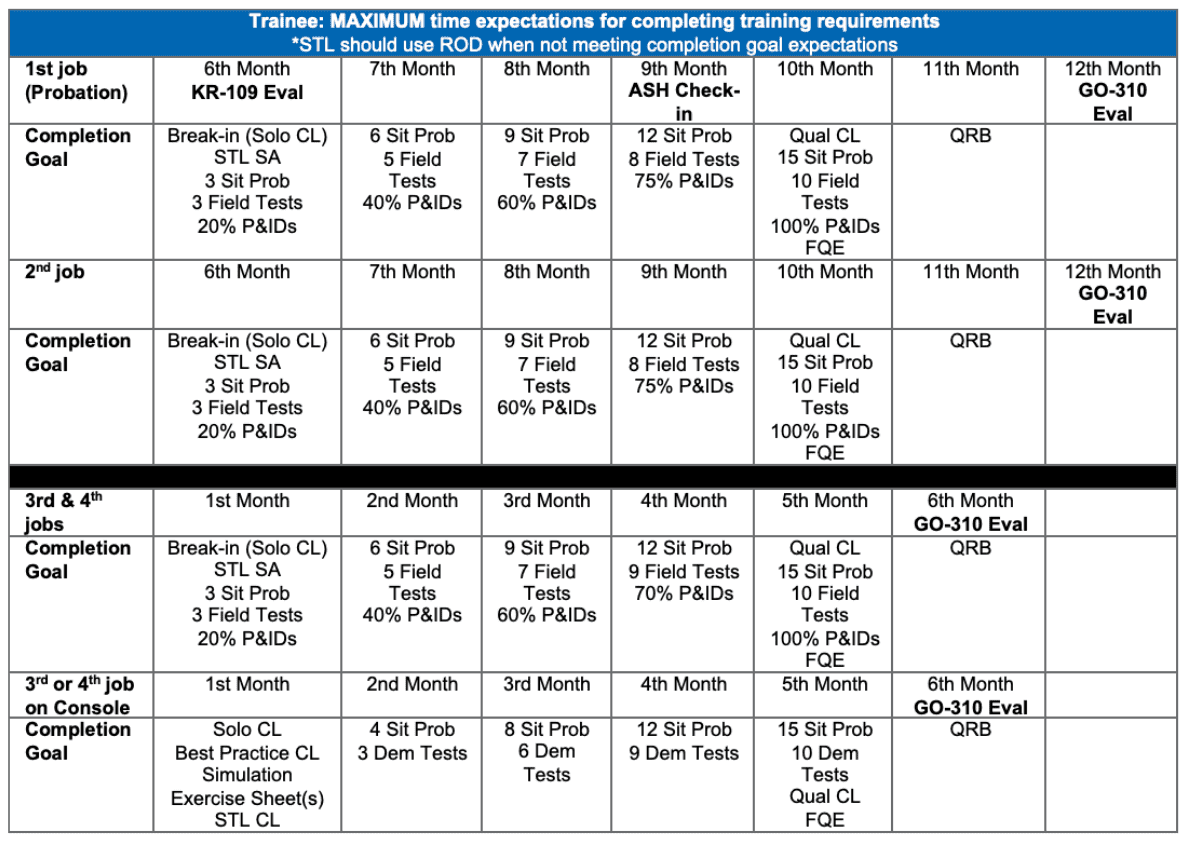
Table 1: Trainee Job Training Timeline
All Chevron new hire Operators must complete a one-week orientation program to familiarize the new employee with Chevron business practices. Orientation includes instruction on the following topics:
Throughout the first eight weeks of training, a foundational knowledge of refinery processes and equipment are delivered through a variety of methods.
Trainees return to L&D for one week during their second year of employment as scheduled by the FOTP coordinator. The content focuses on monitoring and troubleshooting fixed and rotating equipment.
Trainees return to L&D during their third year of employment as scheduled by the FOTP coordinator. The content begins to focus on refinery wide systems, processes and procedures.
Trainees are required to achieve a minimum passing score on each assessment to successfully complete the training program. Refer to Table 2 for GFOTP assessment requirements and corrective actions.

Table 2: GFOTP Corrective Action Guide
Question
What topics are covered in the Chevron new hire Operators' orientation program?
Answer the question above the continue reading. iTELL evaluation is based on AI and may not always be accurate.
This component is comprised of seven uninterrupted 12-hour shifts and is required prior to first job unit school. During this period, a job qualified operator is assigned to work with the trainee. The trainee observes the operator to learn and gain first-hand experience of the plant, processes, hazards, and operator responsibilities.
Unit School training is required for each job. The unit school’s emphasis is placed on the Electronic Operating Manual (EOM) for each specific plant.
Unit School Duration
The minimum duration for unit schools is determined by the Unit School Scheduled Hours matrix published online.
Unit School Logistics
Unit schools shall be conducted off-shift. During unit schools, the instructor and the student are relieved of job responsibilities, unless responding to a unit emergency. Unit schools must be conducted in a classroom setting allowing time for field reinforcement. Daily training schedules are established, and activities are developed to meet objectives.
Unit School Exceptions
The Unit School may address more than one job where operating plants are inter-related and approved by area leadership. In these instances, OTJ training requirements and qualification events may be combined.
Post job school job shadowing is required for each job. This comprises of ten to fifteen uninterrupted 12-hour shifts for the first job. Subsequent jobs require shadow training with length to be determined by the STL in consultation with crew Head Operators. During post job school shadow training, the Break-in Guide (Solo Checklist) must be completed.
The break-in guide is required for each job and used by the trainer to instruct on plant operations, potential hazards, routine duties, equipment, and procedures. It may be used during pre-job school shadow training as a guide prior to attending unit school.
Upon completion of the break-in guide (solo checklist), the STL evaluates the operator trainee. This evaluation will determine the trainee’s knowledge and understanding of the job. Once the STL Solo Assessment is completed successfully, the trainee is allowed to work the job solo.
Working solo is a term used to denote the operator trainee can safely and competently work the job without a shadow trainer. Working solo does NOT mean the trainee is qualified on a job. While working solo on a job, the trainee continues to complete additional OTJ training and qualification requirements. Refer to PEP154 Overtime Administration, Operations for information regarding overtime eligibility.
Situation problems require the trainee to interpret, analyze and evaluate the information presented, determine the cause of problem, arrive at a solution, and determine the result. Completion of 15 situation problems is required.
Field Tests require demonstration of ability to competently perform normal or emergency operator duties. Circumstances may prevent the actual performance of a field test and as a result, some field tests will require an oral explanation of actions while in the field. Completion of 10 field tests is required.
All trainees are required to “walkout” lines on P&IDs to learn plant process and equipment. P&IDs are completed while working solo. Permanent changes incorrectly displayed on the P&ID should be noted using the following conventions:
| Yellow | Existing piping, vessels, controls and instrumentation are correctly displayed |
| Green | Additions to plant are not indicated |
| Red | Deletions from plant are still being displayed |
Completed P&IDs are presented to the HO for review and field verification and approval of markups. The HO will work with the STL to create an MOC for requested changes.
Follow these steps to have P&IDs online updated:
Qualification checklists are designed to evaluate the knowledge acquired by the operator trainee through the completion of all previous OTJ training requirements.
(Pre-requisite: All training documents required for Unit Job Qualification and a completed KR-981 is complete.)
This examination is only required for trainees as they qualify on their first four jobs. To complete the FQE, the trainee notifies the STL and UFT. The STL or UFT ensures all training requirements are completed. The STL or UFT contacts the M&P Specialist for a secure test copy. The UFT, STL, or Head Operator may proctor the FQE while following the testing protocol below:
Closed Book
Examinee Instructions:
Test Proctor Instructions:
After a successful FQE, and prior to beginning training on another job, the QRB meets with the trainee to review training documentation and conduct the interview of the employee. The interview verifies the employee has the necessary knowledge to perform the current job safely and competently. Five primary elements of the QRB include Safety, Environmental Considerations, Process Safety Information, Process Flow and Control, and Safety Instrumented Systems. The KR-984, Qualification Review Board form provides more detail. QRB attendees are as follows:
| Position | Role |
|---|---|
| RBM / ASH (or designee) Required | Ensures the integrity of the process, scores and provides the final decision of advancement or hold. |
| STL Required | Ensures all training documentation is complete, and pre-requisite activities have been completed. Facilitates the interview, asks questions, scores, provides feedback on scoring and documents results on KR-984. |
| Head Operator Required | Participates by asking questions and scores. |
| UFT Required | Participates by asking questions and scores. Provides requested training records and supporting documentation for review. Collects completed training package and delivers to LMS Specialist. |
| Refinery Shift Manager Attendance Optional Invite Required | Observes a sampling of QRBs to audit for quality and consistency in application across all Operations areas. Provides feedback to Operations Leadership about the health of the overall QRB process. May ask questions of the trainee during the QRB. |
| L&D Representative Optional | Attends at the request of the business unit. Serves as an observer of the process and may provide feedback on the facilitation of the QRB or performance of the candidate during the QRB. |
Table 3: QRB Roles
Upon successful completion of the QRB, the trainee is considered job qualified. The UFT forwards the completed training package to the LMS Specialist. The LMS Specialist files the original hard copy training material and gives electronic credit.
Question
What is the purpose of the Final Qualification Exam (FQE)?
Answer the question above the continue reading. iTELL evaluation is based on AI and may not always be accurate.
To maintain qualification, the trainee must work a minimum of two 12-hour shifts in each qualified job in any 12-month period.
Have HRBP review GO307-15, Record of Discussion, prior to delivering to employee.
| Evaluation Type | Assessor | Min Score | Evaluation Failure Response | Time to Retest |
|---|---|---|---|---|
| Unit School Test | Instructor | 80 | 1st Failure: GO307-15 2nd Failure: BOR for potential termination | 72 hours |
| Solo CL (Break-in) | OTJ Trainer | N/A | N/A | N/A |
| STL Solo Assessment | STL | 80% 80%>retest>75% | 1st Failure: GO307-17 (retest) 2nd Failure: BOR for potential termination Less than 75%: Termination | 2 weeks |
| Field Test | HO or STL | Pass | 1st Failure: GO307-15 2nd Failure: BOR for potential termination | 2 weeks |
| Situation Problem | HO | Pass | 1st Failure: Inform STL and UFT (resubmit) 2nd Failure: GO307-15 3rd Failure: BOR for potential termination 4th Failure (if allowed resubmit): Termination | 2 weeks |
| Qualification Checklist | HO or STL | Pass | 1st Failure: GO307-15 (retest) 2nd Failure: BOR for potential termination 3rd Failure (if allowed retest): Termination | 2 weeks |
| Final Qualification Exam | UFT or HO | 80% 80%>retest>75% | 1st Failure: GO307-17 (retest) 2nd Failure: BOR for potential termination Less than 75%: Termination | 2 weeks |
| QRB | RBM/ASH or designee | Advance | 1st failure: GO-307-15 STL indicates improvement recommendations. 2nd failure: BOR for potential termination | 2 weeks |
Circumstances Affecting Training Progression
Certain circumstances may delay or prevent Trainee’s promotion in the training program and/or pay progression to the next level. Some examples of circumstances that may affect progress include but are not limited to:
STL Action To Submit a Promotion:
For FQO promotions, the O&M Training Supervisor will facilitate the recognition tasks (R&A and certificate). The O&M Training Supervisor will continue to send STLs a reminder for yearly promotions one month in advance of trainee service anniversary, for those who have not promoted earlier.
| Progression Step | Time Frame | Completion Requirements |
|---|---|---|
| OT1 | 6 months from hire | GFOTP 1.0, Break-in Guide (Solo Checklist), STL Solo Assessment, 3 Situation Problems, 3 Field Tests, successful KR-109 evaluation |
| OT2 | Earliest - Minimum 1008 hours (84 12-hour shifts) of soloing on Job 1 Maximum time: complete by 1st year service anniversary | OT1 + Qualified on 1st job, successful GO-310 evaluation |
| OT3 | Earliest – Minimum 672 hours (56 12-hour shifts) soloing on Job 2 Maximum time: complete by 2nd year service anniversary | OT2 + Qualified on 2nd job, successful GO-310 evaluation |
| FQO | Earliest – Minimum 672 hours (56 12-hour shifts) soloing on Job 3 and Minimum 672 hours (56 12-hour shifts) soloing on Job 4 Maximum time: by 3rd year service anniversary | OT3 + GFOTP 2.0 + GFOTP 3.0 + Qualified on 3rd and 4th jobs (Console can be 4th job), successful GO-310 evaluation |
Table 5: Program Advancement & Pay Progression
Note: Non-vacation absences may result in an extension of the training period. Extensions are considered on a case-by-case basis and for extenuating circumstances. The STL consults with the HRBP to determine length of extension, if any. A Training Program Waiver form, KR-988, must be approved by the ASH indicating circumstances, length of extension, and withholding of pay progression until requirements are met.
Last updated at